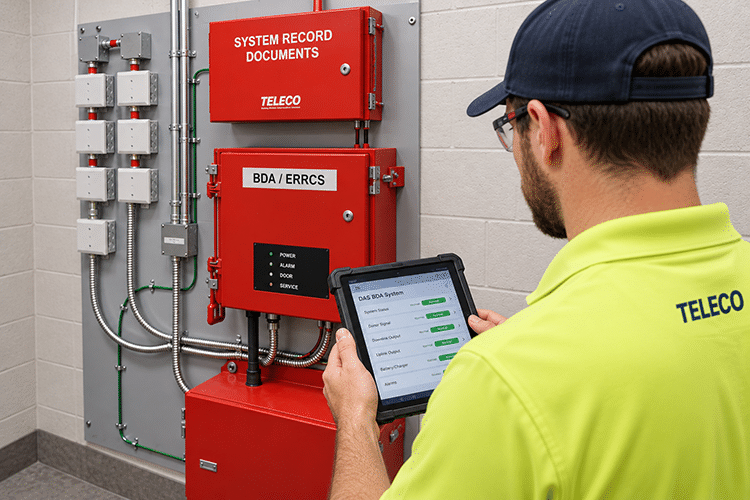
- Delivers the necessary signal strength (RSSI) in all required areas
- Maintains signal quality without interference or noise
- Covers critical zones, including stairwells, basements, mechanical rooms, elevators, and parking garages
- Meets the National Fire Protection Association (NFPA 1225) and International Fire Code (IFC 510) requirements
- Passes Authority Having Jurisdiction (AHJ) inspections for occupancy permits and ongoing compliance
- NFPA 1225 for Emergency Responder Communications Enhancement Systems (ERCES)
- IFC Section 510 for in-building emergency radio coverage
- AHJ-specific criteria, including battery backup, alarm supervision, and NEMA enclosure ratings
- Hospitals and healthcare campuses
- Commercial high-rises and office buildings
- Stadiums, arenas, and public venues
- Hotels, resorts, and casinos
- Government and municipal buildings
- Warehouses, factories, and logistics centers
Frequently Asked Questions
What does DAS Field Testing measure?
DAS Field Testing measures in-building radio signal strength (RSSI), signal quality, and coverage to identify dead zones, interference, or noise. Testing covers relevant public safety frequency bands, such as VHF, UHF, and 700/800 MHz, to evaluate communication coverage for emergency responders.
Which building areas need attention during DAS Field Testing?
Testing checks required areas throughout the building, including stairwells, basements, mechanical rooms, elevators, and parking garages. Construction materials, floor layouts, and mechanical obstructions can weaken signals, so a site survey and coverage maps help identify problem areas.
How does DAS Field Testing support code compliance?
Testing evaluates system performance against NFPA 1225, IFC Section 510, and applicable Authority Having Jurisdiction (AHJ) criteria. Compliance validation also addresses requirements such as battery backup, alarm supervision, and NEMA enclosure ratings. The resulting report provides documentation for AHJ review and approval.
What happens if DAS Field Testing identifies coverage deficiencies?
Depending on the findings, corrective measures may include repositioning antennas, adding repeaters, or installing boosters. Once performance metrics are met, the compliance report documents test data, coverage maps, and remediation actions to support inspections and ongoing maintenance.