Short answer: In the BDA vs DAS question, a BDA (bi-directional amplifier) is the signal booster, and a DAS (distributed antenna system) is the network of cables and antennas that carries that boosted signal through the building. In most public safety installations, the two work together: the BDA amplifies first responder radio signals in both directions, and the DAS delivers them to stairwells, elevators, garages, and other hard-to-reach areas. Whether your building needs a BDA, a DAS, or both is decided by radio coverage testing and the requirements of your local authority having jurisdiction (AHJ).
What Is a BDA?
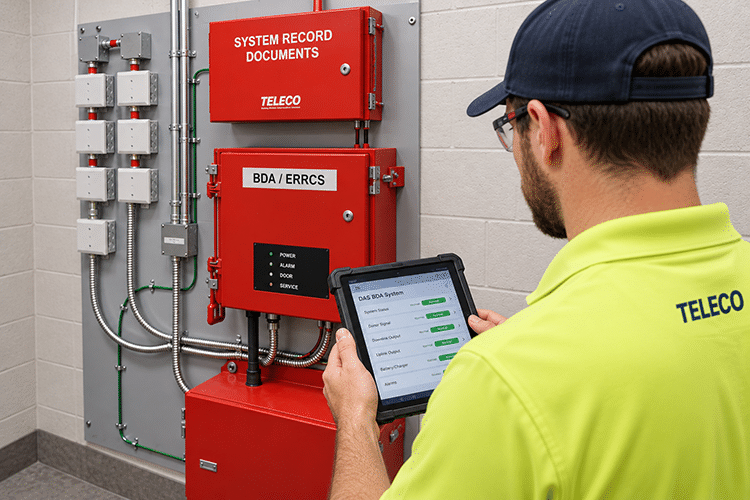
A bi-directional amplifier is an active device that boosts radio signals traveling in two directions: downlink signals coming from the public safety radio network to responders inside the building, and uplink signals going from responder radios back out to the network. The BDA connects to a donor antenna, usually mounted on the roof, which has a clear line of sight to the nearest public safety tower.
What Is a DAS?
A distributed antenna system is the infrastructure that spreads signal throughout a structure. It includes coaxial or fiber cabling, splitters, and indoor antennas placed so coverage reaches every required area. A DAS can carry public safety radio frequencies, commercial cellular frequencies, or both, depending on how it is designed.
BDA vs DAS: How Do They Work Together?
Think of the BDA as the engine and the DAS as the road system. The donor antenna captures the outside signal, the BDA amplifies it, and the DAS distributes it to indoor antennas on each floor. When a firefighter keys a radio in a basement stairwell, the process runs in reverse so the transmission reaches the dispatch network.
When a BDA Alone Can Be Enough
In a smaller building with only a few weak areas, a BDA with a limited number of antennas may provide the required coverage. Even in these cases, the antennas and cabling form a small DAS.
When a Full DAS Is Required
Large buildings, high-rises, hospitals, parking structures, and facilities built with concrete, steel, or energy-efficient glass typically need a full DAS with many antennas and, in some cases, fiber-fed remote units to reach every floor.
What Is the Difference Between a Public Safety BDA and a Cellular Booster?
They are not interchangeable. A public safety BDA is built for first responder frequencies, such as 700 MHz, 800 MHz, and P25 networks, and must meet life safety requirements like battery back-up and system monitoring. A cellular booster improves commercial carrier signal for phones and does not satisfy public safety radio requirements.
Which Codes Apply in a BDA vs DAS Decision?
Emergency responder radio coverage requirements are commonly based on the International Fire Code (IFC) Section 510 and NFPA 1225. These standards address signal strength, coverage percentages in critical areas such as stairwells and fire command centers, battery back-up, monitoring, and periodic testing. Every jurisdiction adopts and amends these codes differently, so your AHJ sets the exact requirements for your building. Our overview of public safety DAS requirements for 2026 covers what building owners should expect before inspection.
How Do You Know If Your Building Needs a BDA or DAS?
Follow these practical steps to settle the BDA vs DAS question for your property:
- Contact your AHJ early. Ask which code edition applies, what coverage levels are required, and which frequencies the local public safety network uses.
- Schedule a radio coverage test. A grid test measures signal strength throughout the building and identifies where coverage falls short. Professional DAS field testing provides the documented results you need.
- Review the results against code. If the building meets required coverage without amplification, a system may not be needed. If it does not, the test shows where coverage must be added.
- Design the system. Engineers determine whether a BDA with a few antennas or a full DAS is needed, and plan antenna placement, cabling, and back-up power. Professional DAS design and engineering keeps the project on schedule.
- Install, commission, and test. After installation, acceptance testing confirms coverage, and annual testing keeps the system ready.
Who Is Responsible for the BDA or DAS in a Building?
In most jurisdictions, the building owner is responsible for providing adequate emergency responder radio coverage. Owners typically work with a qualified integrator for design, installation, and testing, and with the AHJ for review and approval.
How TELECO Helps With Public Safety BDA and DAS Projects
For over 45 years, TELECO has delivered communication technology for commercial buildings. Our team handles Public Safety DAS projects from RF site surveys through design, installation, commissioning, acceptance testing, and annual performance and battery back-up testing. Using iBwave design software and PCTEL test equipment, TELECO engineers systems around your building’s structure and provides documented results for your AHJ’s review. Call 800.800.6159 to schedule a coverage assessment.
Frequently Asked Questions
Is a BDA the same thing as a signal booster?
Yes, a BDA is a type of signal booster. In public safety applications, it is a specialized booster built for first responder radio frequencies with life safety features such as battery back-up and alarm monitoring.
What is the difference between a Class A and a Class B BDA?
A Class A BDA amplifies only specific channels, while a Class B BDA amplifies a wider band of frequencies. Your AHJ and the frequency license holder may specify which class is acceptable for the local network.
Can a cell phone booster be used for public safety radio coverage?
No. Cellular boosters are designed for commercial carrier frequencies and do not support first responder radio systems or meet public safety requirements.
How often does a public safety DAS need to be tested?
Most jurisdictions require acceptance testing after installation and periodic testing afterward, commonly once a year. Your AHJ confirms the exact schedule.