If you own or manage a commercial building, chances are you have heard about DAS field testing requirements—but many building owners are unsure of what the process actually involves, how long it takes, and what happens if their system doesn’t pass. This guide walks you through everything you need to know about professional DAS field testing, from the initial walkthrough to the final compliance report.
Whether you are preparing for a new Certificate of Occupancy inspection, meeting annual re-certification requirements, or assessing an existing system after a renovation, understanding the DAS field testing process empowers you to make informed decisions and avoid costly surprises.
What Is DAS Field Testing?
DAS (Distributed Antenna System) field testing is the process of verifying that a building’s in-building radio coverage system meets the performance standards required by local fire codes, the International Fire Code (IFC 510), and NFPA 1225. The testing specifically evaluates the Emergency Responder Radio Coverage System (ERRCS)—the infrastructure that ensures first responders can communicate clearly via two-way radio throughout a building during an emergency.
A DAS field test is not a visual inspection. It is a signal measurement exercise performed by certified RF engineers using calibrated test equipment to measure actual radio frequency (RF) signal levels at defined test points throughout the building.
Who Requires DAS Field Testing?
Most Authorities Having Jurisdiction (AHJ)—typically the local fire marshal or building department—require DAS field testing in the following situations:
- New construction: before a Certificate of Occupancy (CO) is issued
- Renovation or buildout: when physical changes may affect RF coverage
- Annual re-certification: to confirm ongoing compliance with code requirements
- System modifications: after changes to the BDA, antennas, or cabling infrastructure
- Post-incident assessment: after an emergency event raises concerns about system performance
The specific requirements vary by jurisdiction, but NFPA 1225 and IFC 510 have become the benchmark standards that most AHJs follow. Buildings that fail to maintain compliance risk notices of violation, suspension of occupancy permits, and liability exposure.
The DAS Field Testing Process: Step by Step
Step 1: Pre-Test Documentation Review
Before testing begins, the engineering team reviews the building’s as-built DAS system documentation—system diagrams, equipment lists, installation records, and any prior test reports. This review helps identify known coverage challenges, equipment changes since the last test, and the AHJ’s specific testing protocol requirements for the jurisdiction.
Step 2: Walk-Through and Test Point Identification
The testing team conducts a building walk-through to identify required test points. Under NFPA 1225 and IFC 510, testing is required in all areas of the building—with particular attention to:
- Stairwells and elevator shafts
- Basement levels and underground parking
- Mechanical and electrical rooms
- Areas of refuge and evacuation routes
- Rooms with significant RF-blocking materials (lead-lined rooms, concrete-reinforced areas)
Step 3: Signal Measurement and Data Collection
Using calibrated test equipment such as a Fluke Networks analyzer or equivalent RF measurement tool, the team measures signal strength at each test point across all required frequency bands:
- 700/800 MHz (primary public safety frequencies)
- UHF and VHF bands used by local emergency services
- FirstNet Band 14 (where required by the AHJ)
- Any additional frequencies specified by the local fire marshal
Both inbound (from the BDA donor antenna to the building interior) and outbound (from portable radios inside the building to the donor antenna) signal levels are measured. Results are compared against the minimum signal strength thresholds required by the applicable code.
Step 4: Battery Backup Verification
NFPA 1225 requires that ERRCS systems include battery backup capable of maintaining full system operation for a minimum of 12 hours during a commercial power failure. The testing team verifies backup battery capacity and condition—an area where many older systems quietly fall out of compliance as batteries age.
Step 5: Coverage Analysis and Gap Identification
Once all measurement data is collected, the engineering team analyzes results to identify any areas where signal levels fall below code-required thresholds. These are documented as coverage gaps, along with their precise location within the building and the frequency bands affected.
Step 6: Test Report and AHJ Submission
The final deliverable is a comprehensive certified test report that includes:
- A complete list of test points with measured signal levels
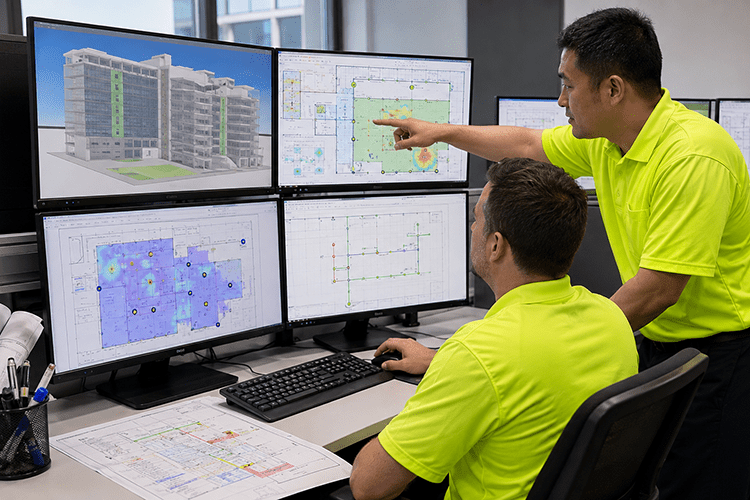
- RF coverage heatmaps showing signal strength distribution throughout the building
- Pass/fail status for each required frequency band
- Battery backup test results
- Identification of any coverage gaps with remediation recommendations
- System documentation suitable for AHJ review and approval
If the system passes, the report serves as your compliance documentation. If gaps are identified, the report provides the information needed to design and implement targeted remediation—whether that involves adding antennas, adjusting amplifier output, or replacing degraded equipment.
How Long Does DAS Field Testing Take?
The duration of a DAS field test depends on the size and complexity of the building. As a general guideline:
- Small commercial buildings under 50,000 sq ft: typically one day
- Mid-size commercial or multi-story buildings: one to two days
- Large complexes, hospitals, or multi-building campuses: two to five days or more
- Report preparation and AHJ submission: typically two to five business days after testing
What Happens If Your Building Fails?
A failed DAS field test is not the end of the road—it is the beginning of a remediation plan. The test report will identify exactly where coverage is insufficient and on which frequency bands. In most cases, remediation involves one or more of the following:
- Adding antenna locations to fill coverage gaps
- Adjusting BDA amplifier output levels
- Replacing aging or degraded coaxial cable and connectors
- Installing additional signal splitters or amplification stages
- Replacing battery backup systems that no longer meet capacity requirements
A qualified DAS contractor can complete most remediation work and schedule a re-test promptly. Working with the same team that performed the initial test streamlines the process significantly.
TELECO’s certified RF engineers have been performing professional DAS field testing for commercial buildings across the United States for over 40 years. From initial inspection preparation to post-remediation re-certification, we guide building owners through every step of the compliance process—delivering AHJ-ready reports, certified heatmaps, and the technical expertise to resolve any coverage challenge identified.
We also design and install Public Safety DAS systems that are engineered from the ground up to pass inspection the first time, minimizing rework and protecting your project timeline. For buildings requiring Cellular DAS upgrades alongside ERRCS compliance work, TELECO provides integrated solutions that address both commercial connectivity and life-safety requirements in a single engagement.
To schedule a certified DAS field test or discuss your building’s compliance status, contact TELECO at 800.800.6159 or visit www.teleco.com/das-field-testing/.
Frequently Asked Questions
How often is DAS field testing required?
Most jurisdictions following NFPA 1225 and IFC 510 require annual testing and re-certification of ERRCS systems. Some AHJs require testing every two years. The specific frequency is determined by your local fire marshal or building authority—when in doubt, annual testing is the safest approach to maintain continuous compliance and avoid lapses that could result in a notice of violation.
Does DAS field testing disrupt building operations?
In most cases, DAS field testing can be conducted with minimal disruption to building tenants and operations. The testing team works through the building systematically, and most measurement activities are non-invasive. For large or complex buildings, testing may be scheduled in phases to minimize impact on occupied floors or sensitive areas such as operating rooms in healthcare facilities.
Can the same contractor who installed the DAS system perform the field test?
Yes, the installing contractor can perform the field test—but many building owners prefer to use an independent testing firm to ensure objective results. An independent certified testing team provides an unbiased assessment of system performance and is often viewed more favorably by AHJs reviewing the compliance documentation. TELECO provides independent DAS field testing services for systems installed by any contractor.
What is the difference between a DAS site survey and a DAS field test?
A DAS site survey is conducted before a system is installed to assess the building’s existing RF environment, identify coverage challenges, and inform the system design. A DAS field test is performed after the system is installed to verify that it meets code performance requirements. Both are essential steps in the lifecycle of a compliant ERRCS installation—the site survey shapes the design, and the field test confirms the result.